
Rent increase 2026: by what percentage can your rent go up?
3 min readBy the RentBolt editorial teamUpdated onYour landlord may raise the rent every year, but never without limit. How much your rent may go up at most depends on the type of rental home you have: social housing, mid-rent or the private sector. This article sets out the percentages for 2026 and explains how to check whether your increase is within the rules.
Maximum rent increase per type of home in 2026
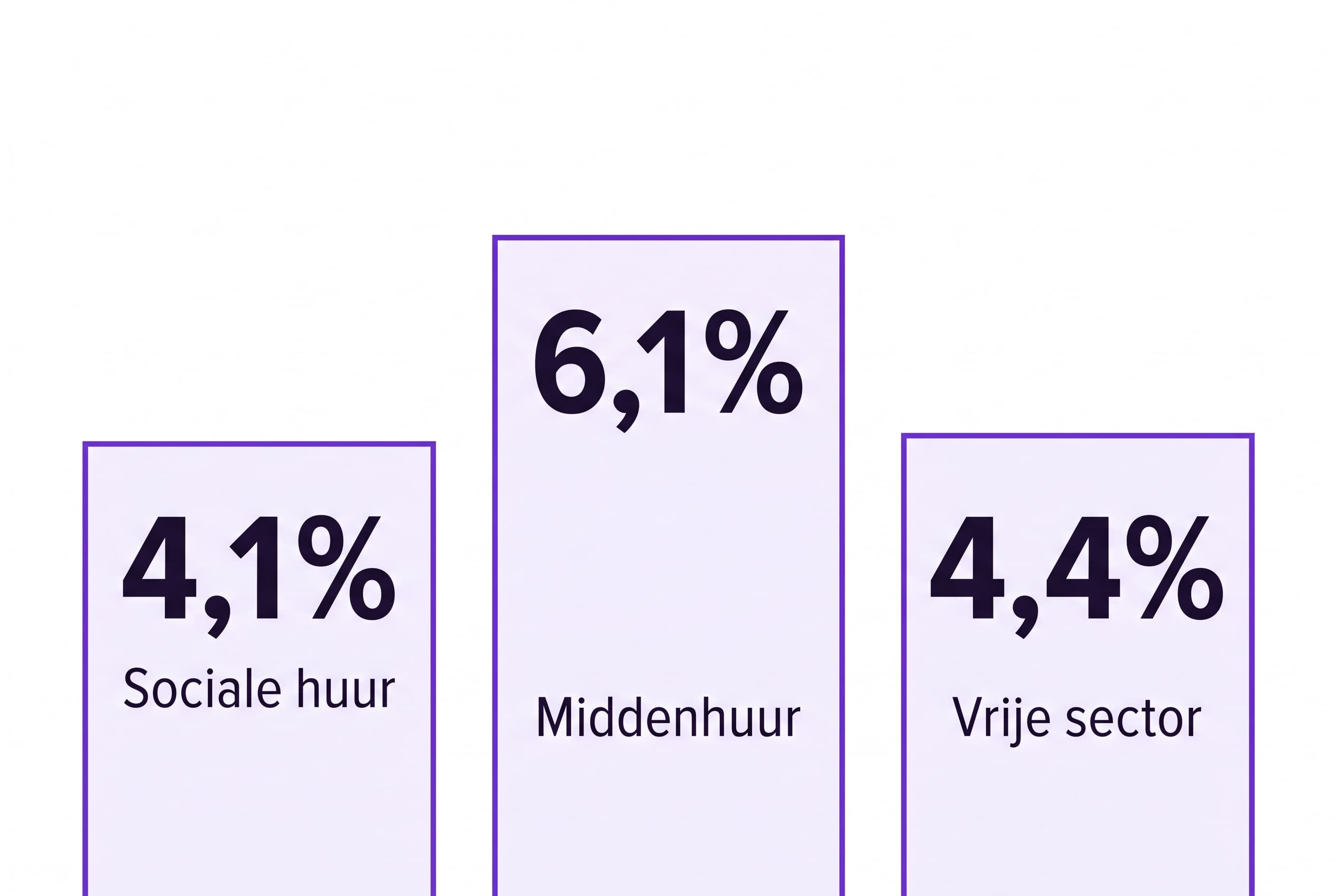
| Type of rental home | Maximum increase |
|---|---|
| Social housing (basic rent €350 or more) | 4.1% |
| Social housing (basic rent below €350) | At most €25 |
| Mid-rent | 6.1% |
| Private sector | 4.4% |
Social housing
For a social rental home, the landlord may raise the basic rent from 1 July 2026 by at most 4.1%, provided the basic rent at that time is €350 or more. If your basic rent is below €350, a fixed maximum of €25 applies instead of a percentage. Tenants with a higher income may face an income-dependent increase: a fixed amount of at most €50 (higher middle income) or €100 (high income) instead of the percentage. Your income from two years earlier determines which group you are in. For 2026 the threshold is a combined income of €59,504 (single-person household) or €68,858 (multi-person household) for the higher middle income, and €70,149 and €93,531 respectively for the high income. Check the current rules at Volkshuisvesting Nederland, as these thresholds change every year.
Mid-rent
For mid-rent contracts, a maximum rent increase of 6.1% has applied since 1 January 2026. This percentage is based on collective agreement wage growth from December 2024 to December 2025 (5.1%), plus a fixed 1 percentage point.
Private sector
If you rent a home in the private sector, the annual rent increase in 2026 may be at most 4.4%. Note: this maximum only applies if your tenancy agreement does not set another (lower) percentage or a different indexation method; in that case the contractual arrangement takes precedence, as long as it is not higher than the legal maximum.
How do I know what type of rental home I have?
So the rules differ considerably per category, and it is not always immediately clear which category your home falls into: that depends on its WWS points. If in doubt, ask your landlord or check the points calculation for your home with the Rent Tribunal. Read social housing, private sector or mid-rent: the difference explained for the exact points thresholds per category.
What must your landlord do to be allowed to raise the rent?
A rent increase does not happen automatically. The landlord must inform you in writing at least two months before the intended effective date, stating:
- The current basic rent
- The proposed new amount
- The date the increase takes effect
- A reference to the legal basis for the percentage
If this announcement is missing, or the landlord exceeds the permitted percentage, the increase is not simply valid.
Do you disagree with the proposed increase?
You do not have to just accept a rent increase if you suspect it is wrong. For a social rental home you object to your landlord, preferably in writing and before the date the increase takes effect. If the landlord then does not go to the Rent Tribunal, the proposed increase does not go ahead. Read is your rent too high? Do the rent check with the Rent Tribunal for the exact procedure and deadlines.
Rent increases and rent benefit
If your rent goes up, the calculated rent used for your rent benefit also changes. So after a rent increase it is wise to do a new test calculation; read more in applying for rent benefit: conditions and amounts 2026.
What happens if the landlord exceeds the percentage?
If the landlord exceeds the legally permitted percentage, the rent increase is not legally valid for that part, even if you have already been paying the new, higher rent for some time. You can then reclaim the excess retroactively. If in doubt, keep paying the old rent in the meantime, and let the landlord first come up with a correct justification, rather than routinely agreeing to every proposed amount.
Frequently asked questions
May my landlord raise the rent mid-year, outside the annual round?
No. A rent increase may in principle only happen once every twelve months, except for an increase after a demonstrable improvement to the home (such as a renovation), for which separate arrangements apply.
Does the rent increase also apply if I have a temporary tenancy agreement?
Yes. With a temporary contract the landlord can also apply the annual rent increase, unless the contract sets a fixed rent for the entire term.
Can I object to a rent increase in the private sector?
For private-sector homes there is less room to object through the Rent Tribunal than for regulated rents, but if the landlord exceeds the legal maximum of 4.4%, you can still challenge it through the subdistrict court.
Search rental homes in the top cities
See the current listings and set up rental alerts for popular cities in the Netherlands:
Read also
Ready to start searching?
RentBolt searches the listings of 500+ letting agents across the Netherlands in one overview, and alerts you as soon as something that suits you becomes available.