
Affordable Rent Act: what changes for tenants in 2027?
4 min readBy the RentBolt editorial teamUpdated onThe Affordable Rent Act (Wet betaalbare huur) has been in force since 1 July 2024 and is meant to keep the rent of mid-priced homes affordable. Now that the number of rental homes owned by private landlords is shrinking, the cabinet wants to amend the act. This article sets out what has been announced, what is not yet certain and what it means for you as a tenant or home seeker. Status: based on sources from August 2026.
How the act works now
The points system (the Home Valuation System, WWS) determines which segment a home falls into and the maximum rent that may be asked:
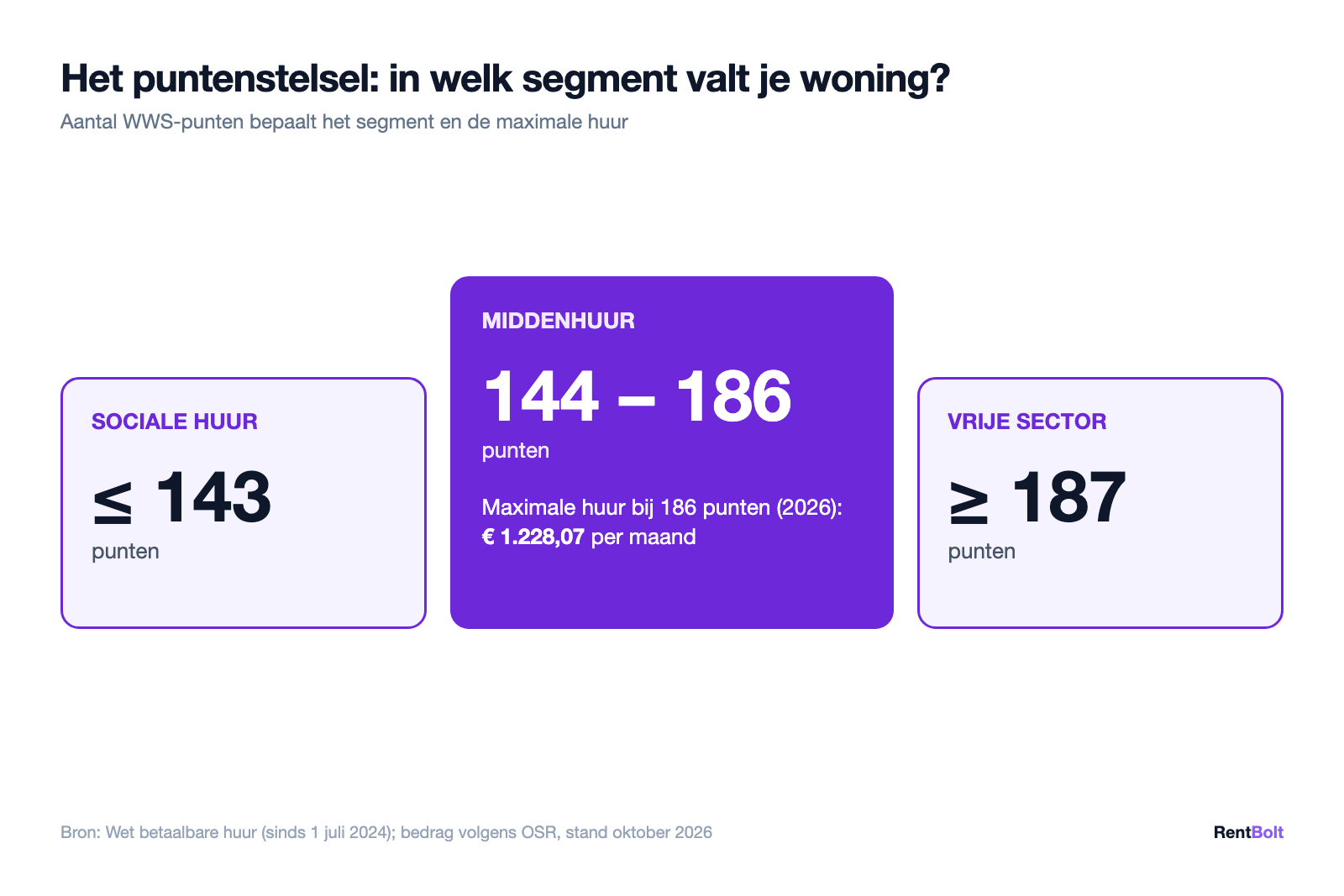
| Segment | Number of points |
|---|---|
| Social housing | Up to and including 143 points |
| Mid-rent | 144 to 186 points |
| Private sector | From 187 points |
In 2026, a home with 186 points has a maximum rent of €1,228.07 a month (according to the OSR knowledge centre; see the sources at the bottom). A few rules that directly affect tenants:
- Since 1 January 2025 a points calculation must be provided with every new tenancy agreement.
- You can have the initial rent assessed by the Rent Tribunal within six months of the start of the agreement. Read how the rent check works.
- Since 1 January 2025 municipalities can enforce the rules themselves.
- The maximum annual rent increase for mid-rent was 6.1% in 2026 (see rent increase 2026).
What has been announced?
In a letter to parliament of 20 April 2026, the minister announced a number of changes meant to keep the supply of mid-rent homes up. There are five parts:
- Price premium at the WOZ cap: homes that run into the WOZ value cap get extra room in the maximum rent, without the number of points changing.
- No more minus points for homes without private outdoor space such as a balcony, garden or roof terrace.
- The WOZ value counting more heavily for small listed buildings.
- Temporary tenancies of at most two years for students: this option is being widened.
- A 10% new-build premium for twenty years: this now applies to mid-rent new builds where construction started before 1 January 2028, and would be extended to construction starts up to 2032.
In addition, the cabinet announced in the 2026 Spring Memorandum that transfer tax for landlords will fall from 8% to 7% from 1 January 2027. The cabinet also wants housing associations to build 5,000 mid-rent homes a year from 2029, out of the at least 12,000 the cabinet says are needed each year.
What is certain and what is not?
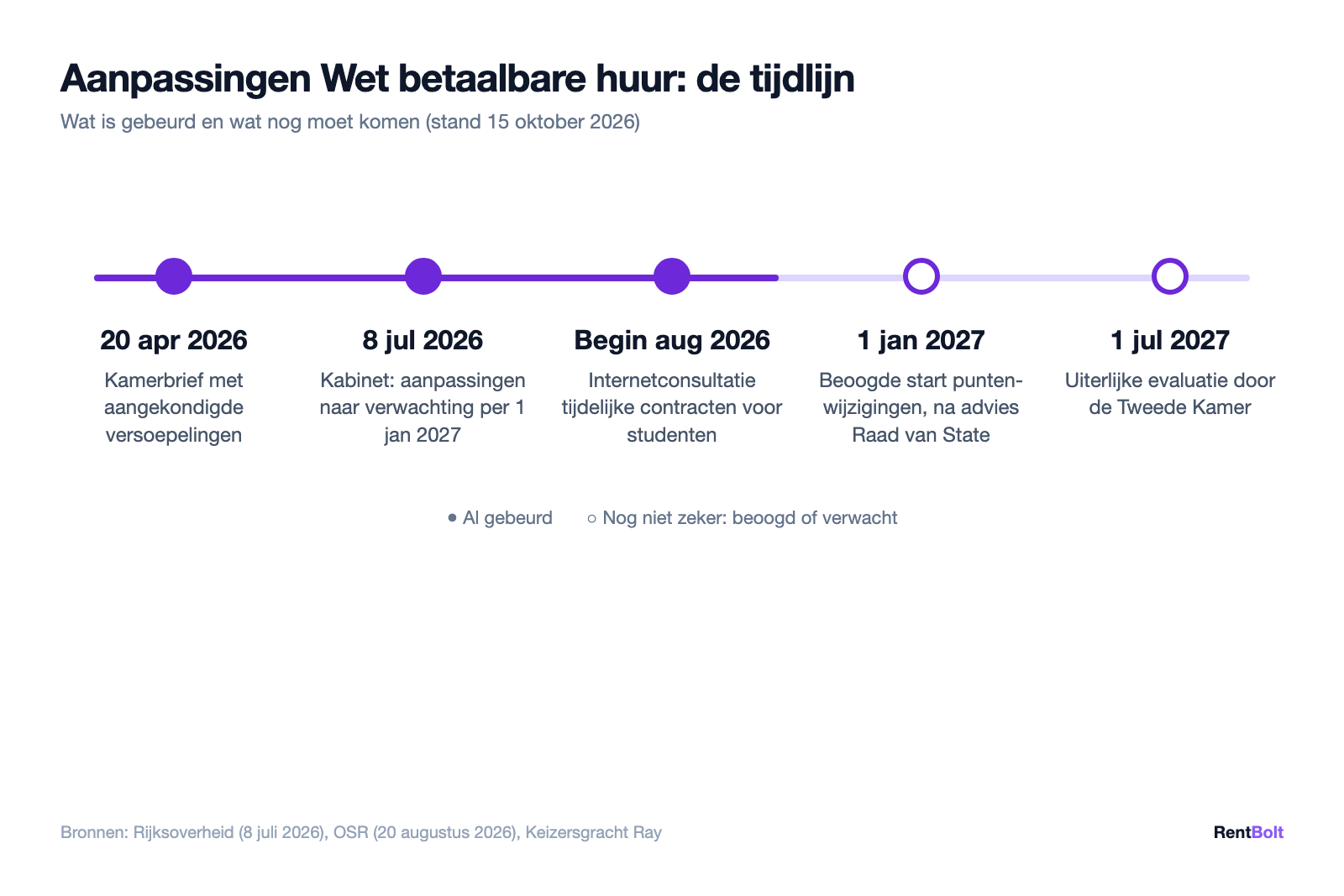
| Part | Status (August 2026) |
|---|---|
| Points changes (1 to 3) | Announced; intended from 1 January 2027. According to Stadszaken, the Council of State had no comments on the draft decree for the WOZ cap |
| Temporary contract for students | Requires a change in the law; according to the consultation documents the arrangement will be added to the bill later |
| Extension of the new-build premium | Announced; not yet put out for consultation |
| Transfer tax 8% to 7% | Announced by the Dutch government for next year |
Important for existing tenants: existing tenancies cannot be raised straight to the new maximum after a change. The formal evaluation of the act must reach the House of Representatives by 1 July 2027 at the latest.
What does this mean if you are looking for a home?
- Always ask for the points calculation. That shows whether the home really falls into the middle segment and whether the rent asked stays within the maximum.
- Check the rent within six months. If you think you are paying too much, you can have the initial rent assessed.
- Do not count on a quick improvement. The announced measures are meant to support supply over time, but building extra mid-rent homes takes years. Responding quickly therefore remains important; see tips for finding a rental home.
- Be careful with temporary contracts. Since permanent tenancies became the norm, temporary tenancies are only allowed to a limited extent, for example for certain students. Read the difference between temporary and permanent.
Want to see what rental homes in your city currently cost on average? Look at our overview page with current rents.
Sources and status
This article is based on the OSR knowledge centre (20 August 2026), a report by Stadszaken (18 August 2026), the letter to parliament of 20 April 2026 and the 2026 Spring Memorandum. The proposals may still change and the status may have changed after August 2026; we will update this article as soon as there is a final decision.
Frequently asked questions
Will my rent go down or up because of the changes?
Nothing changes automatically for existing tenancies. According to current reports, existing tenancies cannot be raised straight to the new, higher maximum after a change. The changes mainly apply to new lettings and to the maximum rent a landlord may ask.
Can I have the rent of my home assessed?
Yes. With a new tenancy agreement you can have the initial rent assessed by the Rent Tribunal (Huurcommissie) within six months of the start of the agreement. Since 1 January 2025 the landlord must also provide the points calculation with every new tenancy agreement.
Are the announced changes already law?
No, they are the cabinet’s plans. Some are intended to take effect from 1 January 2027; that is a target date, not a fixed fact. Temporary contracts for students require a change in the law.
Search rental homes in the top cities
See the current listings and set up rental alerts for popular cities in the Netherlands:
Read also
Ready to start searching?
RentBolt searches the listings of 500+ letting agents across the Netherlands in one overview, and alerts you as soon as something that suits you becomes available.